
AGRICULTURAL MRV

From observations to a defensible assessment.

Understand monitoring, reporting and verification, why agricultural evidence is difficult and what a methodology-specific workflow can support.

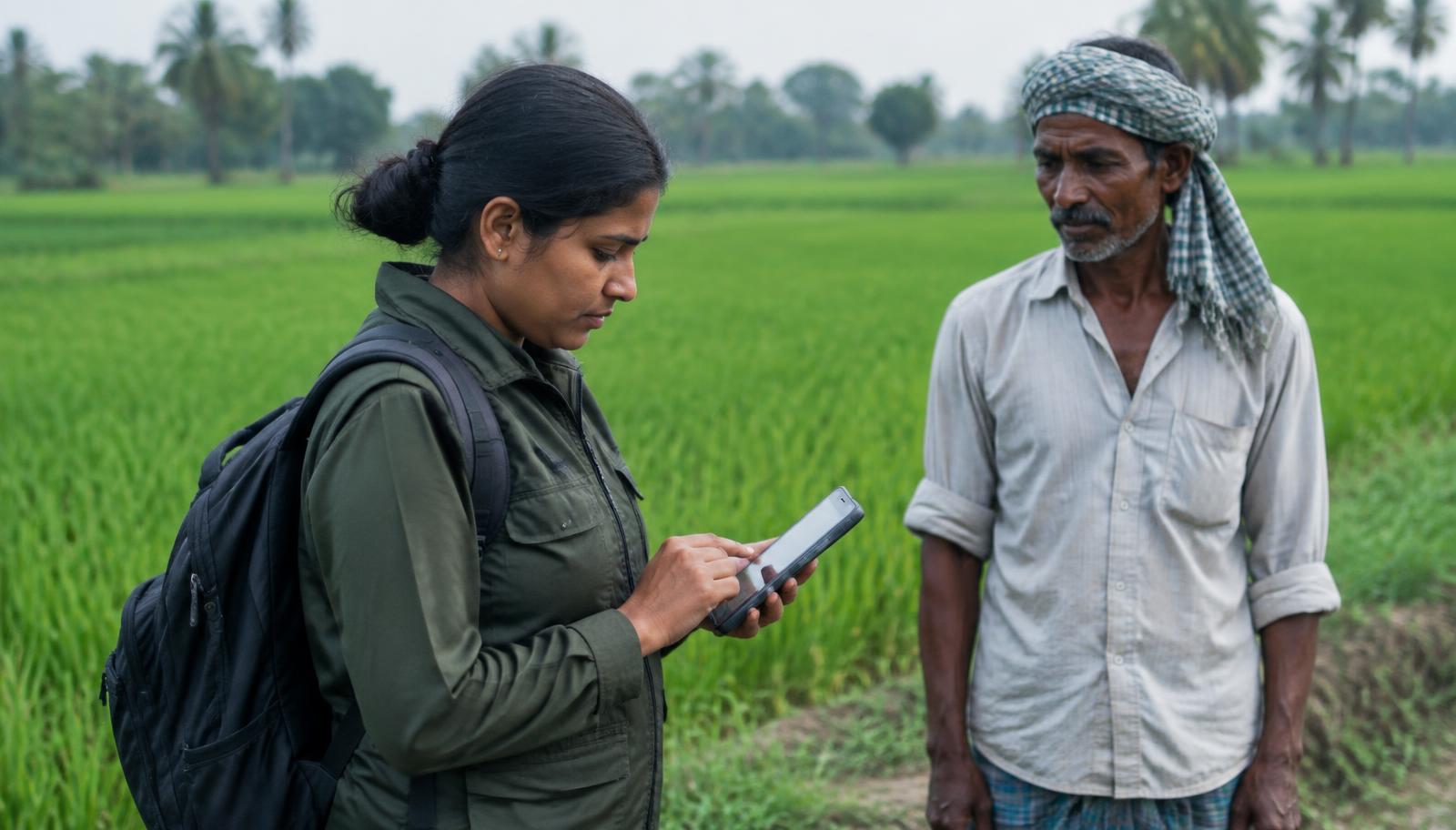
Illustrative field observer recording an agricultural observation with a farmer
Field observation · illustrative scene
FROM THE FIELD TO THE RECORD

Keep each observation in its place.

A field, crop season, activity and source record need to remain connected for later interpretation.

AGRICULTURAL MRV · SOURCE TO REVIEWIllustrative model
Field observationsWho · when · where01
Satellite contextCoverage · date · quality02
Farmer recordsReported activity · season03
Supporting filesPhotos · documents · sensors04
CONNECTED RECORDEvidence
package
Field · season · claim
01Quality checksCompleteness · consistency
02Human reviewGaps · exceptions · rationale
Decision recordedOutcome depends on criteria
Evidence sources can support or qualify a claim. The connected record retains their origin, timing and limitations for review.
CAPABILITY STATUS

Platform design · capabilities described below are proposed unless explicitly identified as available. Product examples are illustrative, not live monitoring or verified results. Implementation and integrations are agreed for each program.

01 / IN DETAIL

Monitoring, reporting and verification are different tasks

Monitoring collects and assesses observations, measurements and records about a field, practice or environmental indicator over a defined period. Reporting presents those sources, calculations, assumptions, findings and limitations in a structured form. Verification evaluates whether the evidence supports a specific claim under defined criteria and an applicable methodology.

Monitoring software supports a verification process; it does not replace an independent verifier where one is required.

02 / IN DETAIL

Why agricultural MRV is difficult

Fields differ in size, crop stage, management and seasonal conditions. Observation sources differ in reliability, spatial coverage and timing. Delayed records, missing measurements and environmental variability complicate comparison across programs.

  • Baselines and comparison groups must be suitable for the intended claim.
  • Measurement uncertainty should accompany indicators and calculations.
  • Consistent protocols and versioned methodologies are needed across locations.
03 / IN DETAIL

A traceable monitoring workflow

Define the field, season and claim before choosing observations. Identify required measurements, collect from approved sources and associate each record with the correct location and period. Assess completeness and quality, flag gaps and preserve the observation history.

  • Output: a monitoring record with identifiable sources and dates.
  • Missing or late evidence remains visible.
  • A monitoring record is not automatically a verified impact result.
04 / IN DETAIL

From raw records to reporting

A proposed report assembles scope, reporting period, field coverage and source coverage. It presents applicable calculations and indicators alongside exclusions, missing data, uncertainty and review status. Aggregated reporting retains links to field-level records rather than obscuring unresolved cases.

  • Include evidence completeness and methodology reference.
  • State calculation assumptions, units and limitations.
  • Retain review decisions and audit history.
05 / IN DETAIL

Verification under defined criteria

Define the claim and methodology, check evidence requirements, examine contradictory sources and escalate uncertainty. Data validation checks structure and completeness; analytical assessment interprets evidence under a method; verification decides whether that evidence supports the claim.

These terms are not interchangeable. A validation pass is not a verified environmental outcome.

06 / IN DETAIL

Confidence without an unexplained score

Confidence depends on source reliability, spatial relevance, timing, completeness, agreement between independent sources and measurement uncertainty. The proposed review view exposes these dimensions separately, along with methodology compliance and final status.

An uncalibrated AI score must not be presented as the probability that a claim is true.

07 / IN DETAIL

Practice adoption is not environmental impact

An irrigation-practice record does not itself establish water saved. Quantification needs a defensible baseline, suitable measurements, a defined method and transparent assumptions. The same distinction applies to yield, soil outcomes and greenhouse gas reductions.

  • Separate observed activity from calculated environmental indicators.
  • Identify baseline, method version and measurement coverage.
  • Report uncertainty and exclusions rather than promising benefits.
08 / IN DETAIL

Designed MRV outputs

The platform design supports monitoring histories, completeness assessments, methodology-based calculation records, exceptions and review queues, traceable reports and evidence packages for further verification. Each methodology should document scope, eligible claims, inputs, rules, calculations, limitations, version and review process.

Program-specific methodologies and outputs must be agreed and validated. No certification or credit issuance is implied.

ONE WORKED EXAMPLE

A claim follows the same field through every stage.

Illustrative practice-adoption case. Not a live field, production workflow or environmental result.

SAMPLE FIELD A-024 · RICE · DEMONSTRATION SEASON

Define program

Illustrative question: was the specified rice practice implemented on field A-024 in the demonstration season?

Program design
  • Scope: practice adoption, not quantified impact
  • Required: boundary, dated activity log and corroborating observation
  • Method: demonstration criteria v1, not an accredited methodology
Explicit program and evidence requirements
START WITH A CONVERSATION

Build a clearer picture
of agricultural impact.

Talk with The Carbon Credit about a DSR program, field evidence requirements, research collaboration or a potential project partnership.